New Construction Contractor Selection California: What to Evaluate
Get a practical California guide to vetting new-construction contractors, comparing proposals, checking credentials, coordinating design, and planning controls.
|
November 6, 2026
In this article:
New construction contractor selection California homeowners can feel confident about starts with evidence, not just a polished portfolio or a low estimate. Match a contractor’s experience to your project, verify credentials and insurance, clarify who coordinates design and approvals, and compare written proposals line by line before signing.
Discuss your new-construction plans
How do you approach new construction contractor selection California homeowners can trust?
Set your selection criteria before you interview
Begin with a short project brief. Note whether you are replacing an existing home or building on a vacant parcel, the approximate size and complexity, the property’s location, your design status, and the decisions that are still open. Include practical constraints such as access, utility connections, grading, trees, neighboring structures, and whether you expect to live nearby during construction. You do not need a finished specification to start a conversation, but you should be clear about what is known and what remains uncertain.
Then write down what matters most to you. One homeowner may put design coordination first because the drawings are still developing. Another may need a clear site-work plan or frequent updates because the property is far from home. Ranking priorities helps you ask the same questions of each candidate and makes it easier to see whether a proposal addresses your actual concerns.
California residential construction has many moving parts and handoffs. A Cal Poly study examines productivity in California’s residential construction industry; it provides context for why coordination and planning deserve attention, not a forecast or promise about any individual project. Read the Cal Poly study.
Ask for examples that match the work
Ask each contractor to describe recent projects with a similar scale, construction type, site condition, or level of design complexity. A new home on a straightforward lot can pose different coordination challenges from a replacement build with tight access, existing structures, or complex grading. Ask what the contractor personally managed and what was handled by the owner, architect, engineer, or subcontractors.
Request references for comparable work and ask permission to contact them. Use consistent questions: Was the scope clear before work started? How did the contractor communicate changes? Were questions routed to someone who could make a decision? How were schedule shifts explained? Did closeout include the documents and corrections the homeowner expected? A reference’s specific account is more useful than a general endorsement.
Understand the actual team and accountability
Find out who will be your primary contact, who supervises the site, who coordinates trades, and how those people share updates. Ask how often the responsible lead is on site and who answers when that person is unavailable. It is reasonable for staffing to vary with project phase; what matters is knowing who owns each decision and how a concern reaches them.
Also ask how subcontractors are selected and coordinated. Rather than assuming one staffing model is right for every project, clarify who schedules trades, checks that prerequisite work is ready, communicates site rules, and resolves conflicts between drawings or installations. These answers give you a picture of how the team works when a real coordination issue appears.
How can you verify credentials, insurance, and references?
Check the business identity and license record
Ask for the legal name of the business that will sign the agreement and the contractor license number. Verify the record through the California Contractors State License Board’s official lookup resource. Review the listed status and classification, and confirm that the identity on the record matches the contracting party in the proposal. If a salesperson, project manager, or affiliated business has a different name, ask how the entities relate and who is legally responsible for the work.
Do not treat a number printed on a business card as proof that the record is current or fits the proposed scope. Make a note of the date you checked, save the relevant details, and check again near signing if time has passed. If names, status, or classification do not line up, pause and ask for a clear written explanation. Resolve the discrepancy before paying or authorizing work.
Ask for current insurance documentation
Request documentation for coverage relevant to the proposed work and ask who can confirm that it remains active. Clarify how the contractor verifies coverage for subcontractors and whether the project’s scope or site conditions raise questions that should be reviewed by an insurance professional. Policy types, limits, exclusions, and the homeowner’s own property coverage depend on individual circumstances, so do not rely on a general conversation as a substitute for professional advice.
Ask practical questions about site access, protection of adjoining property, safety expectations, and how incidents or damage are reported. The goal is not to replace a formal safety plan or contract. It is to learn whether the team can explain its normal process and identify who will respond if a concern arises.
Use references to test communication, not only workmanship
References can help you understand the experience behind the finished photos. Ask how often the homeowner received updates, whether decisions and changes were recorded, and how the contractor handled an unresolved question. Ask what the homeowner would clarify earlier if starting again. Avoid asking a reference to judge matters outside their direct experience; instead, compare several detailed accounts with what the contractor has told you.
Keep a simple record for each call: project type, what the reference directly observed, strengths they described, concerns or caveats, and follow-up questions. If one reference describes a smooth process but cannot say who actually supervised the work, that is useful information. It suggests a specific question to bring back to the contractor rather than a reason to draw a broad conclusion.
What should be settled in design and approval coordination?
Make the design status visible
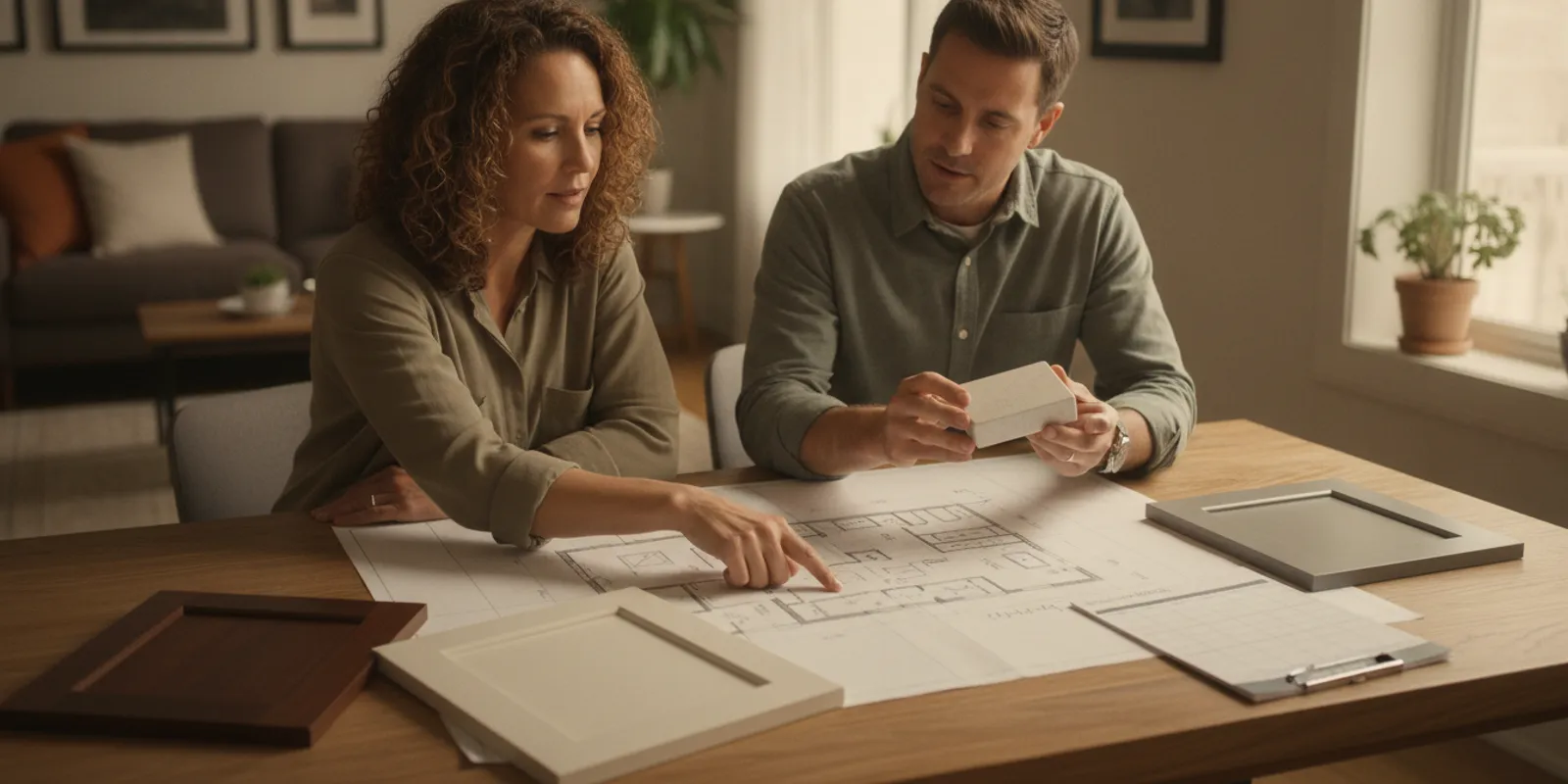
Before treating a proposal as a firm comparison, list the documents and decisions that are complete. This may include architectural plans, structural engineering, site information, energy or other required design details, and selections that affect specifications. The exact documents depend on the property and project. Ask the contractor which information was used to prepare the proposal, which assumptions remain, and what additional work is needed before pricing and schedule can be refined.
Identify who coordinates the architect, engineers, consultants, and construction team. The owner may retain separate design professionals, or the project may use another agreed arrangement. Either way, name the responsible party for gathering questions, distributing current drawings, and resolving conflicts. Do not assume design services or consultant fees are included unless the agreement says so.
Map approvals and responsibility
Ask which approvals or reviews may apply to the property and who will prepare, submit, revise, and track each item. Clarify who responds to comments, who pays fees, and how design revisions are authorized. The permitting authority determines its review process and timing; a contractor can explain its coordination approach, but should not promise an outcome controlled by a public agency.
Use a responsibility list rather than relying on a loose statement that “the team will handle permits.” For each approval, record the item, person responsible, required input, submission status, and next action. If an application depends on a survey, engineering detail, or owner selection, state who obtains it and when. This makes dependencies easier to spot before they hold up the next phase.
Investigate site conditions before they become assumptions
Walk through the known site questions with the contractor. Discuss access for workers and deliveries, grading, drainage, utilities, trees, neighboring structures, and any existing conditions that may need investigation. Ask which studies or inspections have already been completed and which are recommended. A proposal should distinguish what has been observed from what is assumed.
For each unknown, agree on a process: what information will resolve it, who will obtain that information, and how a change to scope or cost will be proposed if findings differ from expectations. No one can responsibly price every unseen condition with certainty. A documented method for dealing with unknowns is more useful than treating an assumption as a confirmed fact.

How should you compare new-construction proposals?
Give each candidate the same scope information
When possible, provide candidates with the same current drawings, project brief, site information, and list of known selections. Tell them what is still undecided and ask them to label assumptions rather than silently filling gaps. If one contractor receives a newer plan set or a different description of the work, the totals will not be an apples-to-apples comparison.
Build a checklist that marks each item as included, excluded, allowance, owner-provided, or not yet determined. Ask for written clarifications and a revised proposal when the answer changes the scope. The table below can serve as a starting point; expand it for systems, finishes, or special site requirements that matter to your project.
| Proposal area | Questions to ask | What to compare |
|---|---|---|
| Plans and coordination | Which drawings, consultants, and coordination tasks are included? | Deliverables, responsible person, exclusions, and drawing versions |
| Site preparation | What investigation and site work are included or assumed? | Defined work, unknowns, access, and change process |
| Materials and finishes | Are products specified, or carried as allowances? | Quantities, quality level, allowance basis, and selection deadline |
| Schedule and supervision | Who manages the work and how are updates provided? | Milestones, dependencies, contact person, and reporting cadence |
| Changes and payments | How are changes approved and payment requests documented? | Written procedure, supporting records, and contract terms |
| Inspections and closeout | What inspections, corrections, and handover items are covered? | Completion criteria, records, manuals, and remaining responsibilities |
Read the assumptions behind the total
A lower price can reflect a narrower scope, fewer specified products, or assumptions that have not been tested. A higher price may include more coordination or a more complete specification. Neither total is automatically the better choice. First find out whether the candidates priced the same work, then decide which differences matter to your priorities and how much uncertainty you are willing to carry.
For each allowance, ask what the amount covers, how an actual selection will be reconciled, and what happens if the chosen product costs more or less. For each exclusion, identify who will arrange that work, whether it must happen before a specific construction phase, and how it affects the schedule. Request a written response instead of trying to remember verbal explanations.
Work through a sample bid difference
Imagine Proposal A is lower, but it lists site preparation as “per final conditions” and carries several finish allowances. Proposal B is higher and identifies specific site tasks, product assumptions, and a more detailed coordination scope. Do not conclude that A is a bargain or B is excessive from the totals alone. Ask A what conditions are excluded and how changes will be priced; ask B which defined tasks account for the difference.
Then record the answer in a common comparison sheet. For example, write “site access improvements: included up to the stated scope,” “utility investigation: owner to provide,” or “fixture selection: allowance, selection due before rough-in.” Replace those sample labels with the actual written terms. If a candidate cannot make a key assumption clear, mark it unresolved rather than assigning it an optimistic value.
Which contract terms and project controls should you discuss?
Check that the agreement matches the proposal
Before signing, confirm the parties, project address, scope documents, price structure, payment terms, anticipated schedule, change procedure, and responsibility for design coordination and approvals. Check that referenced drawings and attachments are included, dated, and consistent with the proposal. Ask which document governs if the agreement, an attachment, or a later clarification appears to conflict.
Read the payment provisions carefully. Understand what milestone triggers a request, what documentation accompanies it, and who reviews questions. Do not assume that a payment schedule is standard or appropriate for every project. Ask a qualified California construction attorney or other relevant professional about legal questions or terms you do not understand before signing.
Put change control in writing
Agree on a process for additions, deletions, substitutions, and site-condition changes. A useful written change request identifies what is changing, why it is changing, the cost effect, any schedule effect, and who must approve it. Ask whether work begins only after written approval and how an urgent condition is handled. Keep the approved change with the current scope documents so everyone is working from the same version.
Consider a practical example: a selected window differs from the basis in the plans. Before authorizing a substitution, confirm whether the change affects cost, dimensions, related finishes, installation sequencing, or any review that may be required. Record the decision and update the selection list. A small change can touch other parts of the work, so a repeatable review prevents “we thought that was included” misunderstandings.
Set communication and recordkeeping habits early
Choose a regular update cadence and decide how urgent issues are raised. Identify who can make decisions for the contractor and who speaks for the homeowner. Agree where current plans, selections, change approvals, inspection records, meeting notes, and payment documentation will be stored. A simple shared record is better than searching through old messages when a detail needs confirmation.
A decision log can be a short table with the date, question, person responsible, needed-by date, decision, and approval record. For instance, “confirm exterior finish sample” is more useful when paired with who will provide the sample, who approves it, and the date needed to avoid disrupting the next task. Review open items regularly and close the loop in writing.
Ask for a schedule that explains dependencies
A single projected completion date does not show how the team expects work to proceed. Ask for a milestone view that includes major phases, prerequisite decisions, inspections, long-lead selections, and known dependencies. The schedule will change as design details and site information become clearer, so ask how revisions are communicated and who updates the current version.
Find out which decisions the homeowner must make and how much lead time is needed. If a selection must be final before rough-in or ordering, record the deadline and the consequence of missing it. A schedule that identifies owner decisions can help you act early; it should not be treated as a guarantee against agency review, weather, supply, or other conditions beyond the team’s control.
How can you make a decision without relying on one score?
Compare evidence across the same categories
Use a decision matrix to summarize experience fit, verified credentials, insurance documentation, reference feedback, design and approval coordination, proposal completeness, communication, schedule approach, and contract clarity. For each category, write the evidence you have and what remains unresolved. “Provided two recent references for similar projects” is more useful than “seems experienced.”
You can use simple labels such as clear, needs follow-up, or unresolved instead of pretending that every factor has a precise numerical value. Decide in advance which issues are essential to resolve before signing. A strong presentation cannot compensate for a mismatch in scope or an unclear contracting identity. Likewise, one unanswered question may simply require a document or a follow-up conversation; evaluate the response, not just the existence of a question.
Know when to pause and ask for clarification
Pause if the license details do not match the business that will contract, the proposal remains vague after reasonable questions, or you are pressed to commit before receiving written terms. Other reasons to slow down include unexplained differences between promised work and the agreement, reluctance to provide relevant references, and unclear ownership of design coordination or site investigations.
A concern is not proof of misconduct. It is a reason to seek a specific explanation, ask for supporting documentation, or get independent professional advice. If the answer is still unclear, take time to compare another candidate. A clear written response lets you make a decision based on what the contractor is actually agreeing to do.
Keep the homeowner’s own preparation manageable
Before final interviews, assemble the latest drawings, a list of selections already made, known site reports, your priorities, and a record of open questions. Label old plans so they are not confused with current ones. After each conversation, update the same comparison sheet rather than relying on memory. If a contractor gives a verbal answer that changes a proposal assumption, ask for the written version.
Use a final pre-signing review
Before choosing, hold one final review with your preferred candidate and walk through the proposal in the order the work is expected to happen. Start with design handoffs and site preparation, then discuss major construction phases, selections, inspections, changes, and closeout. Ask the contractor to point to the document that defines each responsibility. If the answer depends on an assumption, record the assumption and identify who will confirm it.
This review is also a good time to test communication. Bring a short list of realistic situations: a drawing conflict, a delayed selection, an unexpected site condition, or a question about a payment request. Ask who would be contacted, what information they would need, and how the decision would be recorded. You are not asking the contractor to predict every problem. You are checking whether there is a clear path for resolving one.
After the meeting, compare the written proposal and agreement against your notes. Confirm that promised clarifications appear in the documents, that outdated plans are not attached, and that open items have an owner and a next step. If something remains unresolved, decide whether it is acceptable to proceed with a stated assumption or whether you need the detail settled first. This final check can prevent a friendly conversation from being mistaken for a binding scope.
Realm Living describes a planning approach that pairs homeowners with a dedicated advisor and a pre-vetted contractor network. Homeowners can review how the process works, learn about Realm Living’s approach, and explore related project information for home additions and kitchen projects. For further planning context, browse the home renovation guide library.
Get started with a conversation about your project
Frequently Asked Questions
When should I choose a contractor for a new California home?
Start conversations early enough to compare experience, responsibilities, and process before you need to commit to a construction schedule. The right point depends on how complete the design is, what site investigations remain, and whether approval-related information is available. You can discuss approach earlier, but make sure incomplete information and assumptions are clearly labeled in any preliminary proposal.
Should I select the lowest proposal?
Not until you compare the scope, exclusions, allowances, assumptions, schedule, supervision, and payment terms. Ask candidates to price the same defined work and explain large differences. A lower total may still fit your priorities, but first understand what it leaves open and how those unresolved items could be addressed.
Can I evaluate contractors if my plans are incomplete?
Yes. You can discuss comparable experience, coordination, site questions, and what information is needed for a more complete proposal. Ask candidates to distinguish preliminary assumptions from committed scope, and agree who will obtain missing information. Avoid comparing an early estimate as though it were a fully specified price.
Can a contractor guarantee approval or a completion date?
Public-agency review and project conditions are not fully controlled by the contractor. Ask how the team will track submissions, manage dependencies, and communicate schedule changes. A schedule with milestones and assumptions is more useful for planning than relying on a guaranteed agency outcome or a date that does not explain its dependencies.
Start your California new-construction plan
Bring the next conversation into focus
Gather your current plans, property information, priorities, and unresolved questions before comparing contractors. Verify the contracting identity, align the scope, and document assumptions and decisions so you can judge each proposal on the work it actually describes. Get started with a conversation about your project.